
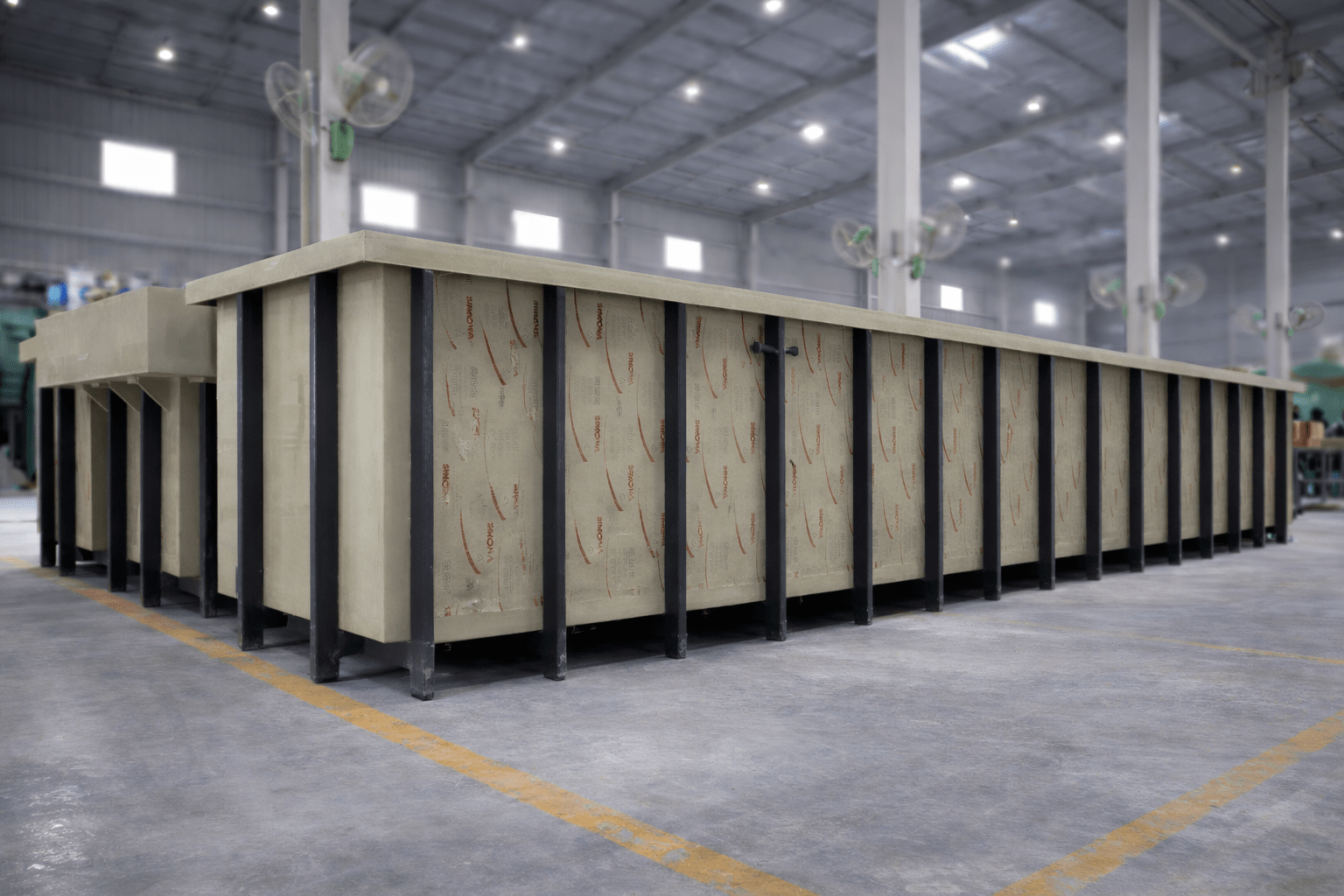
In a pickling line the acid does the work, but the tank decides how safely and for how long the line runs. SH Engitech’s engineering team explains how to match a pickling tank to an HCl, sulfuric acid or nitric acid bath, and what to check on size and fume extraction.
Process
What a pickling tank has to withstand
Pickling removes rust, mill scale and oxide films from metal before it is galvanized, coated, plated or welded. Workpieces such as steel coils, wire, pipes and fabricated parts are lowered into an acid bath, usually after degreasing and before rinsing and fluxing.
Of all the tanks in the line, the pickling tank is under the most stress: strong acid, often heat, heavy loads lowered in by crane, and acid fumes above the surface. A tank that is wrong for the acid or the temperature leaks, warps or needs relining far sooner than it should.
Selection
The key points
- Match the tank to the bath. The acid, its strength and its temperature decide the tank material.
- Size the tank from the workpiece. The largest piece, the immersion depth and the loads per hour set the dimensions.
- Plan fume extraction with the tank. Hood, blower and scrubber work best when designed together.
Acid bath
HCl, sulfuric acid or nitric acid
Each of the three common pickling acids makes a different demand on the tank.
| Acid bath | Typical temperature | What it means for the tank |
|---|---|---|
| Hydrochloric acid (HCl) | Ambient to about 40 °C | Gives off fumes, so extraction is needed. PP and HDPE tanks work well |
| Sulfuric acid (H₂SO₄) | Often heated, around 60–80 °C | Heat is the main challenge. PP or FRP with a suitable resin is common |
| Nitric acid (HNO₃) | Ambient to moderately warm | A strong oxidiser. The liner and resin are chosen for the exact acid mix |
Always design for the actual bath: acid strength, temperature, dissolved iron, any additives and how often the bath is changed.
Material
PP, HDPE or FRP
PP (polypropylene) is the most common choice for HCl and heated sulfuric acid baths, because it handles higher temperatures than HDPE. HDPE is a tough, economical option for HCl pickling and rinse tanks at ambient or mildly warm temperatures. FRP is used for large tanks and where extra structural strength is needed, often with a thermoplastic liner inside, so the liner resists the acid and the FRP carries the load.
Whichever material is used, look at how the tank is joined. Thermoplastic tanks that are butt-fusion welded on proper machines, to a recognised standard such as DVS, have far fewer weak points than hand-welded ones.
“Size comes from the workpiece, not the other way round.”
SH Engitech Engineering Team
Sizing
How big should the tank be?
Start with the longest and widest piece, or the jig or basket that carries it, and add clearance on every side. Then add the immersion depth and enough freeboard that acid does not splash out when loads go in. The number of loads per hour sets how many tanks the line needs. Industrial pickling tanks range from a few hundred litres for small parts to well above 20,000 litres for long sections and coils, and are normally rectangular and built to the client’s drawing.
Fume extraction
Do not leave it for later
Acid fumes corrode the building, the crane and nearby equipment, and they are a health risk for operators. A complete pickling system usually includes:
- A lip extraction or hood along the tank edge
- Corrosion-resistant ducting to carry the fumes away
- An FRP centrifugal blower, since metal fans corrode quickly in acid fumes
- A fume scrubber to clean the air before it is released
Service life
Keeping a pickling tank in service
Inspect welds and corners regularly, because that is where leaks start. Keep the bath within the design temperature: overheating is the most common cause of damage to thermoplastic tanks. Protect the walls and floor with guards where loads are lowered in, and spark test the lining of lined tanks at planned shutdowns to find pinholes early.
Contact
Planning a pickling line?
SH Engitech builds industrial pickling tanks in HDPE, PP and FRP, butt-fusion welded on German Wegener machines to DVS standards, and supplies them with complete fume extraction systems for clients worldwide. Tell us your acid, temperature and workpiece size, and our engineers will recommend the right tank.
Products